

The 1980s took computing out of research labs and corporate basements and put it on desks in American homes and offices. In one decade, the building blocks of nearly everything we use today — personal computers, graphical interfaces, and the networking protocols that still route internet traffic — went from experimental to mainstream.
Understanding where these technologies came from explains a lot about why modern devices work the way they do.
Key Takeaways
- The IBM PC (1981) established the open, modular hardware architecture that still defines most Windows-compatible computers today.
- The Apple Macintosh (1984) brought the graphical user interface — icons, windows, a mouse — to a mass audience, replacing text-only command lines for most everyday users.
- TCP/IP became the internet’s official protocol on January 1, 1983, the “flag day” that unified ARPANET around a single addressing and routing system still used by every device online today.
- MS-DOS and later Windows turned Microsoft into the dominant software platform of the PC era, a position it held for decades.
- Consumer modems and early online services in the 80s introduced ordinary people to dial-up networking, laying the groundwork for the broadband and cloud services used today.
The IBM PC: Personal Computing Goes Mainstream
IBM released the Model 5150 — the original IBM PC — in August 1981, built around an Intel 8088 processor and Microsoft’s newly created MS-DOS operating system. What made it transformative wasn’t raw power; it was IBM’s decision to publish the machine’s technical specifications openly, which let other manufacturers build compatible hardware and software.
That openness backfired on IBM commercially — competitors quickly built “IBM-compatible” clones — but it created the ecosystem that would define personal computing for the next two decades. By 1983, an estimated 10 million PCs were already in use across the United States, and the term “PC” had effectively become shorthand for the IBM-compatible architecture itself.
The Macintosh and the Rise of the Graphical Interface
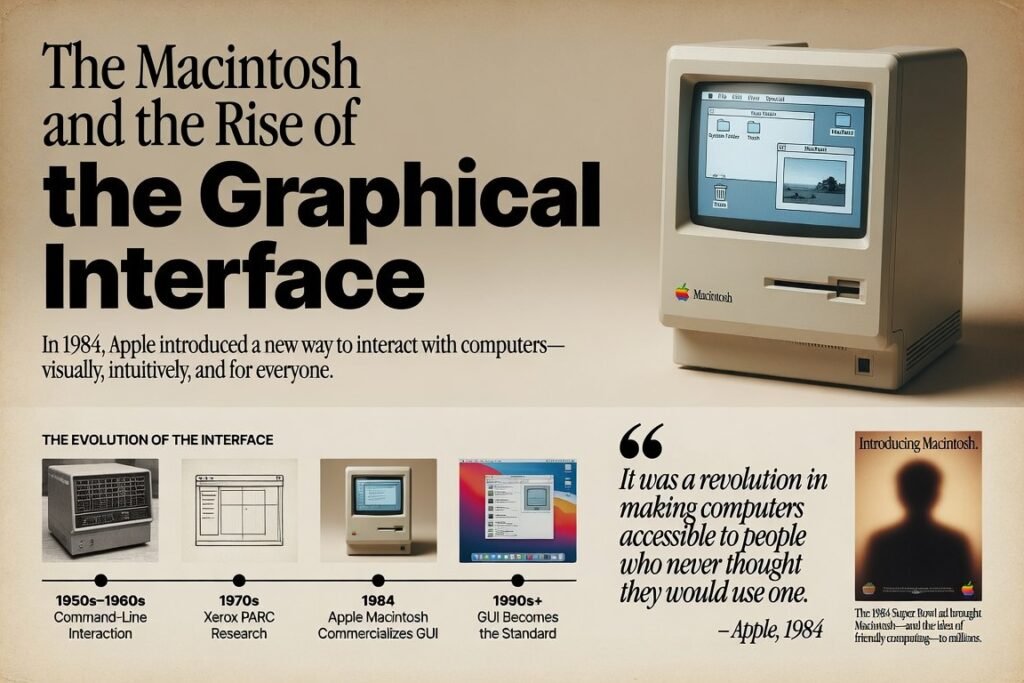
Apple introduced the Macintosh in January 1984, famously announced during Super Bowl XVIII with a one-minute commercial directed by Ridley Scott. The Mac wasn’t the first computer with a graphical user interface — that distinction belongs to Xerox’s PARC research and the Xerox Star workstation a few years earlier — but it was the first to bring windows, icons, and a mouse to a mainstream consumer audience.
This shift mattered enormously: it replaced memorized text commands with visual, point-and-click interaction, making computers usable by people with no technical training. Every modern operating system, phone interface, and app you use today is a direct descendant of that design shift.
TCP/IP: The Protocol That Became the Internet’s Language
Before the 1980s, computer networks spoke different, incompatible languages. On January 1, 1983 — a date networking historians still refer to as “flag day” — ARPANET formally switched over to TCP/IP, the protocol suite that defines how data is addressed, routed, and delivered across networks. IBM’s own System Network Architecture and Digital Equipment’s DECNET were both serious competitors at the time, but TCP/IP’s open, non-proprietary design won out.
That single standardization decision is the reason a phone, a laptop, and a server on opposite sides of the world can all exchange data seamlessly today. Every video call, cloud upload, and web page load still runs on the addressing and routing logic first standardized in 1983.
Modems, Dial-Up, and the First Online Services
Affordable consumer modems — popularized by devices like the Hayes Smartmodem — let home computers connect over ordinary phone lines for the first time. This gave rise to early bulletin board systems and commercial online services, where users dialed in to exchange messages, download files, and access basic information services years before the World Wide Web existed.
Slow and limited by today’s standards, these early dial-up connections established the basic idea that a home computer could reach beyond itself — a concept that broadband, Wi-Fi, and mobile data all build on directly.
Software That Defined the Decade
Alongside the hardware, a wave of 80s software set patterns still visible today. Lotus 1-2-3 (1983) and early spreadsheet tools reshaped business computing. Adobe PageMaker (1985) created the desktop publishing category. Microsoft shipped Windows 1.0 in 1985, its first attempt at a graphical layer over MS-DOS, beginning a rivalry with Apple’s interface that would shape the software industry for years.
Why This Matters Today
None of this is just trivia. The open hardware standards from the IBM PC are why you can mix and match parts when building or upgrading a computer today. The graphical interface principles from the Macintosh are why touchscreens and app icons feel intuitive without instructions. And TCP/IP’s 1983 standardization is the quiet, invisible reason the modern internet works as a single connected system rather than a patchwork of incompatible networks.
When something on a modern device feels frustrating — an incompatible file format, a clunky interface, a networking issue — it’s often because a design decision made decades ago is still working its way through the system, for better or worse.
Conclusion
The 1980s compressed decades of computing progress into a single decade: personal computers moved from labs to living rooms, graphical interfaces replaced command lines, and TCP/IP gave the world a common language for networked communication. Nearly every digital tool in use today — from smartphones to cloud software — builds on foundations laid during this period.
Recognizing that history isn’t just interesting background. It explains why modern computing looks and works the way it does, and why some of its oldest design decisions still matter.
FAQ
What single piece of 80s technology most shaped the modern internet?
The standardization of TCP/IP in January 1983 is generally considered the pivotal moment — it created the common protocol that still routes essentially all internet traffic today.
How did the IBM PC influence today’s devices?
Its open architecture let other companies build compatible hardware and software, establishing the modular, mix-and-match model still used across most Windows-based PCs today.
Was the Macintosh the first computer with a graphical interface?
No — Xerox’s PARC lab and the Xerox Star developed graphical interface concepts earlier. The Macintosh’s contribution was bringing that interface to a mainstream consumer audience for the first time.
Did people really use the internet in the 1980s?
Not in the modern sense. Networking was largely limited to ARPANET’s research and military users, but consumer modems and dial-up bulletin board services gave ordinary people their first taste of networked computing before the World Wide Web arrived in the early 1990s.
Why does 80s computer history still matter for everyday users?
Because so many current standards — file compatibility, graphical interfaces, internet addressing — trace directly back to decisions made in that decade. Understanding the history explains why modern tech behaves the way it does.